Spread Light 358 Print edition
Issue #48 November 14, 2026 · ד׳ כסלו תשפ״ז פרשת תולדות
Cover artwork for Parshas Toldos

This week

Parshas Toldos

November 14, 2026 · ד׳ כסלו תשפ״ז · issue #48. Every piece below is printed exactly as it appears on paper — nothing trimmed.

Gematria on the Parshah: Yitzchak's Love for Esav

Parshat Toldot tells the famous story of Yaakov dressing up as his brother Esav and receiving the blessings from their father, Yitzchak. The Torah tells us that Yitzchak loved Esav, while Rivkah loved Yaakov. But how could Yitzchak, one of the greatest tzaddikim, love Esav so deeply and want to give him the blessings? The answer lies in two remarkable qualities Yitzchak recognized in Esav.

The Strength of Esav

The Zohar explains that Yitzchak loved Esav because they shared the same dominant character trait: Gevurah (strength). Yitzchak recognized Esav's spiritual shortcomings, but also saw the tremendous potential within him.

Esav's trait was to conquer the world. Rome, the great enemy of Israel, descended from Esav. The gematria of עשו (Esav) is 376, the same as מושל (ruler). Esav and his descendants used this power solely for themselves, but had Esav used this power correctly, he could have spread Hashem's light throughout the world.

There is a remarkable allusion to this in Esav's appearance. He was born covered in hair. The word שער (hair) has the same gematria, 570, as רשע (wicked person) and רעש (noise).

The Lubavitcher Rebbe explains that holiness is associated with quietness and humility. The word שקט (quiet) has the same gematria, 409, as the biblical spelling of קדשה (holiness). However, the Rebbe teaches that in our generation we can no longer remain quiet. The forces of darkness loudly proclaim their values, and we must use that same boldness to proudly express our Judaism and spread Hashem's light.

The Head of Esav

Esav's strength was not only physical. He also possessed tremendous intellectual sharpness.

The Torah says Yitzchak loved Esav כי ציד בפיו (because game was in his mouth). Rashi explains that Esav would ask sophisticated halachic questions, such as whether salt and straw required tithing, deceiving his father into thinking he was righteous.

Yaakov teaches us that we can take the strengths of Esav and use them to serve Hashem, without compromising our own holiness.

The Baal Shem Tov explains that רבי (Rabbi) contains the same letters as ריב (dispute). A Rabbi is able to take the negative quality of arguing and disagreeing, and use it for holiness, challenging the status quo and deepening his understanding of Torah. These same qualities are needed to stand up against the darkness of this world.

The gematria of ציד בפיו (game was in his mouth) is 202, the same as רב (Rav). Esav had the brain of a Rabbi. This is why by providence his head was buried in the Cave of Machpelah, but he was missing the heart.

The Holy Sparks of Esav

The Alter Rebbe explains that the ציד בפיו of Esav also alluded to the holy souls that would emerge from his descendants, including some of the greatest figures in Jewish history: Rabbi Akiva, Rabbi Meir and Onkelos.

The Arizal explains that when Yaakov grabbed Esav's heel, he was drawing the future soul of Rabbi Akiva into the Jewish people. The name עקיבא (Akiva) is connected to עקב (heel).

And this is why Yaakov wore the clothes of Esav. He was able to take the good of Esav on an external level and yet remain a tam, pure hearted. The gematria of בגדי עשו (garments of Esav) is 395, the same as רבי עקיבא (Rabbi Akiva).

Yaakov teaches us that we can take the strengths of Esav and use them to serve Hashem, without compromising our own holiness.

The Story of Ovadia

Sefer Melachim relates the story of Ovadia. Ovadia lived during a difficult time period, during the reign of King Achav and his wicked wife Izevel. Izevel sought to eliminate all the prophets of Hashem, and Ovadia was forced to work for the king.

But Ovadia had the strength to stand up against this evil. He hid 100 prophets in two different caves. Even during a famine, he was able to provide food and drink for these prophets. He risked his life and stood up against evil.

Ovadia is the very prophet who prophesied the downfall of Esav. He demonstrated the strength that Esav failed to use correctly: the courage to use deceit to fight the darkness of the world.

Lesson for Us

Let us take the Lubavitcher Rebbe's message to heart. We cannot be afraid to proudly express our Judaism. May we take the strength of Esav, the purity of Yaakov and the courage of Ovadia, and use them to inspire one another to bring Hashem's light to the entire world.

For more, check out the Gematria Torah channel on YouTube!

The Most Dangerous Peace Treaty!

Although Eisav was a bloodthirsty villain, his name represents PEACE.

The Baal HaTurim points out that the Hebrew letters of עשו, Eisav, add up to 376. So do the letters of שלום, peace. How can the name of a man infamous for his murderous rage be equated with peace?

The answer lies in a war we all fight from the moment we are born. One part of our soul yearns for the divine. Another pulls us toward whatever is most comfortable, regardless of the spiritual harm. Eisav's "peace" came from submitting to his savage nature.

When we make peace with our base instincts, we freeze ourselves in place forever. When we choose not to wrestle, we have nothing left to become. Eisav came out of the womb covered in hair, looking like an adult man. Just as on the outside he was fully formed, so too on the inside, he would never grow, because he would never battle his primal urges.

The Torah describes Eisav dragging himself in from the field, unwilling to even lift a spoon to quell his hunger. He tells his brother, Yaakov, to just pour a bowl of lentils down his throat.

Yaakov was the polar opposite of Eisav. He didn't choose the path of least resistance just because it was expedient. Before Yaakov was born, whenever his mother passed the study hall of Shem and Ever, he kicked to get out. This is puzzling because the Sages relate that an angel teaches every unborn baby the entire Torah. At birth, the angel taps the baby's mouth, and every word is forgotten. While he was in his mother's womb, Yaakov had a heavenly tutor and an effortless learning environment. Yet he fought to leave!

Yaakov did not want his Torah handed to him on a silver platter. He wanted to study Torah in a physical body, where he would need to battle for every page. Only what you toil over gets written into your bones.

That restless ache when you push for one more page of learning on an exhausted night? That ache is holy. It is the clearest sign your soul is still growing. Real peace comes after the battle, when your darker side becomes an ally.

Where have you signed a ceasefire in your life? Which battle is G-d waiting for you to rejoin? Stop asking life to pour it down your throat. Pick up that spoon.

The Water Was Always There

Hashem never left. I just stopped digging.

I wonder how often I bury the very thing I'm searching for.

I spend so much of my life trying to get closer to Hashem. I daven, learn, perform mitzvot, and try to do what I'm supposed to do. Yet there are times when that closeness feels elusive.

And I wonder if I've been looking at this all wrong.

Life has a way of filling up. Responsibilities, worries, ambitions, disappointments. Some I choose. Others are thrown at me. And most aren't bad things. I have a family and people depending on me.

But somewhere along the way, these things begin occupying more room in my heart than I realize.

I can be davening while thinking about everything I need to accomplish. Learning Torah while my mind is somewhere else. Doing exactly what I'm supposed to do, yet losing sight of Who I'm doing it for.

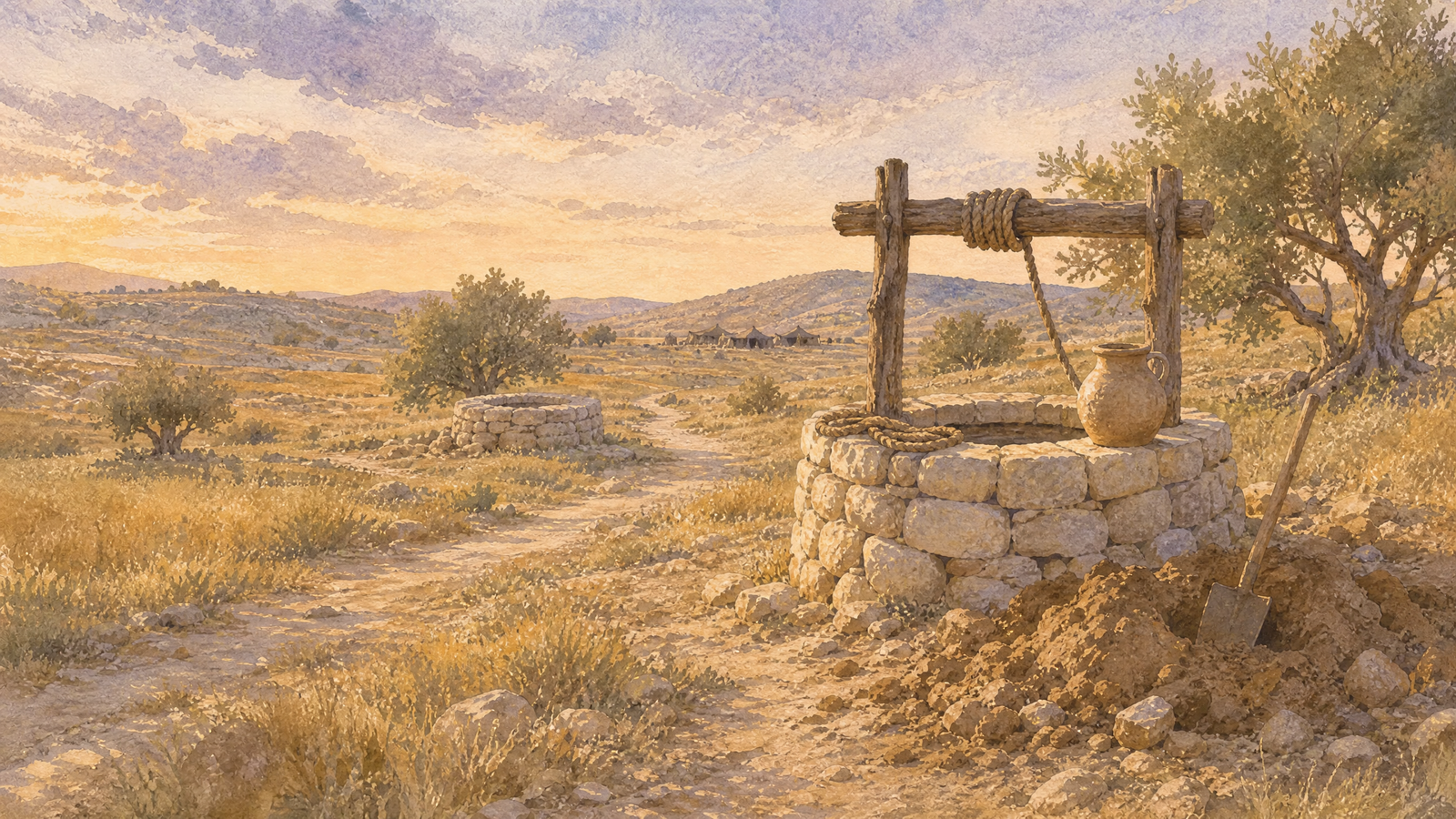
In this week's parsha, the Torah spends an extraordinary amount of time describing Yitzchak Avinu digging wells.

Avraham Avinu changes the world. Yaakov Avinu wrestles with angels.

And Yitzchak?

He digs holes in the ground.

Surely there's something more going on here.

The Torah tells us that after Avraham's death, the Pelishtim filled his wells with earth, וַיְמַלְאוּם עָפָר, "and they filled them with earth" (Bereishit 26:15).

They could block access to the water, but they couldn't eliminate its source.

The Sefat Emet explains that Yitzchak's wells represent Divine light concealed beneath the external layers of this world. He connects the blocking of the wells with ahavot gashmiyot, worldly attachments, and elsewhere discusses sadness and spiritual inertia.

And I find that deeply uncomfortable.

Because I recognize it in myself.

I don't wake up one morning and decide my relationship with Hashem is no longer important. It happens gradually. Another worry. Another disappointment. Something I want. Something I'm afraid of losing.

And perhaps the problem isn't that I love the things in my life. Hashem gave me those things, and I'm supposed to love them.

The problem begins when I forget where they came from and what they're supposed to bring me closer to.

My attachments occupy my heart. Disappointment can become sadness, and sadness can eventually convince me to stop trying.

Layer upon layer of earth.

But the water was always there.

And there's something else that bothers me.

The digging isn't only uncovering the water. It's changing the person holding the shovel.

These weren't originally Yitzchak's wells. They were Avraham's.

Yitzchak inherited them, but he still had to dig.

I can inherit Torah, traditions, and a way of life from my parents and teachers. I can even inherit the knowledge of where to find the water.

But nobody else can do the digging for me.

Rav Simcha Bunim of Peshischa teaches that every Jew must dig a well within himself to attain deveikut, closeness to Hashem.

Perhaps Yitzchak's three wells describe what that digging requires.

The first is Esek (עֵשֶׂק), contention.

And I think that's where it begins. With a fight.

With myself.

What am I really chasing? What occupies my thoughts when I finally have a quiet moment? What have I allowed to become so important that I've left so little room for Hashem?

It's easier to keep busy than to answer those questions.

But how can I remove the earth if I'm unwilling to acknowledge what's filling the well?

Then comes Sitnah (שִׂטְנָה), hostility.

Because recognizing what needs changing and actually changing it are two different things.

I decide to daven with more concentration. To be more patient. To remember Hashem in my decisions rather than only when something goes wrong.

And then tomorrow arrives.

The phone rings. Something goes wrong. I'm tired. I react exactly the way I promised myself I wouldn't.

The yetzer hara doesn't surrender simply because I've decided to improve.

But Yitzchak keeps digging.

Finally, he reaches Rechovot (רְחֹבוֹת), spaciousness.

He says, כִּי עַתָּה הִרְחִיב ה׳ לָנוּ, "For now Hashem has made room for us" (Bereishit 26:22).

And perhaps this is what I've been missing.

I sometimes approach spiritual growth as though it means adding another obligation to an already overflowing schedule.

Another shiur. Another commitment. Another improvement.

But what if getting closer to Hashem isn't only about finding more time for Him?

What if it's about making Him part of the time I already have?

What if my work, my family, my responsibilities, and even my frustrations aren't necessarily distractions from avodat Hashem, but places where I'm supposed to discover Him?

The problem isn't always what I'm doing.

It's what I've allowed those things to become.

Yitzchak found water at Esek and Sitnah. But only at Rechovot did he find spaciousness.

Perhaps because discovering my connection to Hashem and learning how to live within that connection aren't the same thing.

The digging isn't only uncovering the water. It's changing the person holding the shovel.

And then the Torah tells us something remarkable.

After Rechovot, Yitzchak travels to Be'er Sheva, where Hashem appears to him and says, אַל תִּירָא כִּי אִתְּךָ אָנֹכִי, "Do not fear, for I am with you" (Bereishit 26:24).

Those words stop me.

Hashem doesn't say, "Now that you've worked hard enough, I've finally come to you."

He doesn't say, "Now you deserve My Presence."

He says, "I am with you."

He was with Yitzchak at Esek, when everything was a struggle. At Sitnah, when the opposition seemed endless. And at Rechovot, when things finally opened up.

And perhaps that's what I need to remember.

I wasn't digging to bring Hashem closer. I was digging to recognize how close He had been all along.

Then comes my favourite part.

After Hashem reveals Himself, the Torah tells us that Yitzchak's servants dig another well.

Even after the revelation, the digging continues.

Because life doesn't stop happening. The earth doesn't stop accumulating. And my relationship with Hashem isn't something I discover once and never have to work on again.

Sometimes spiritual growth isn't about finding something new. It's about uncovering what I've allowed myself to bury.

And tomorrow?

I'll probably have to start digging again.

Because the water was always there.

And Hashem was with me all along.

Perhaps the question I need to ask myself isn't why Hashem sometimes feels so far away.

Perhaps it's how much earth I've allowed to accumulate between us, and whether I'm willing to pick up the shovel.

What Are You Really Passing Down?

One of the things I think about as a father is how much of what my children learn from me has nothing to do with what I actually teach them.

I can tell them how important it is to be patient, to trust Hashem, to treat people with kindness, and to take responsibility. But what happens when I'm frustrated? How do I speak to their mother when we disagree? What do they see when things don't go my way?

Because whether I realize it or not, they're learning from all of it.

There's something beautiful in this week's parsha, Toldos, that speaks to this.

The Torah begins, "Ve'eileh toldos Yitzchak ben Avraham, Avraham holid es Yitzchak." These are the generations of Yitzchak, the son of Avraham. Avraham fathered Yitzchak.

It's interesting that the Torah repeats the relationship. We already know that Yitzchak is Avraham's son. So why emphasize it again?

Rashi explains that Hashem made Yitzchak resemble Avraham so everyone would recognize that Avraham was his father.

But I think there's another way to reflect on this.

What does it really mean for our children to resemble us?

We spend so much time thinking about what we want to give our children. A good education, strong values, opportunities, financial security, and a meaningful relationship with Yiddishkeit. But sometimes we forget that one of the greatest things we're passing down is the way we experience and respond to life.

We can take responsibility for what we pass on.

A father who constantly needs to be right may unknowingly teach his children that admitting a mistake is dangerous. A father who avoids difficult emotions may teach his children to hide their own. And a father who can acknowledge when he's wrong, apologize, and repair a relationship is teaching something that no amount of lecturing could ever replace.

And I think this is where the work becomes very personal.

Many of us are still carrying patterns we inherited from our own childhoods. Not necessarily because our parents did anything intentionally wrong, but because they were human beings carrying their own struggles. And unless we become aware of those patterns, we can end up passing them on without ever choosing to.

Chassidus teaches that every neshama has its own unique purpose. Our children aren't simply extensions of us. They're souls entrusted to us, with their own journeys and their own relationship with Hashem.

Our responsibility isn't to make them into copies of ourselves. It's to create an environment where they can become who Hashem created them to be.

And sometimes that means doing the difficult work of confronting the parts of ourselves we would rather avoid.

Because the greatest inheritance we leave our children isn't necessarily what we accomplish or what we provide.

It's the emotional and spiritual environment they grow up inside.

And maybe that's the question worth asking ourselves this Shabbos.

What are my children learning about love, about themselves, and about Hashem simply by watching the way I live?

We may not be able to change everything we inherited, but we can take responsibility for what we pass on.

And sometimes the greatest gift we can give the next generation is the decision to stop passing down what hurt us and start passing down what helped us heal.

This week's issue is sponsored by

Reflective questionWhat are my children learning about love, about themselves, and about Hashem simply by watching the way I live?